
500200
Errors found, fixed, shipped & verified in production
It watches production and sweeps your codebase, database & hosting — for the bugs you’ve hit and the ones you haven’t.
You set how far it goes, from suggestions to fully autonomous. Anything that fails its post-merge check reverts itself.
Works with the stack you already ship
Start to finish
From your repo to a fix proved in production.
It ships
Merged to main — immediately, or after your approval. You set which.
It proves the error is gone
Checked against live production after the deploy. If that fails, the change reverts itself.
The project
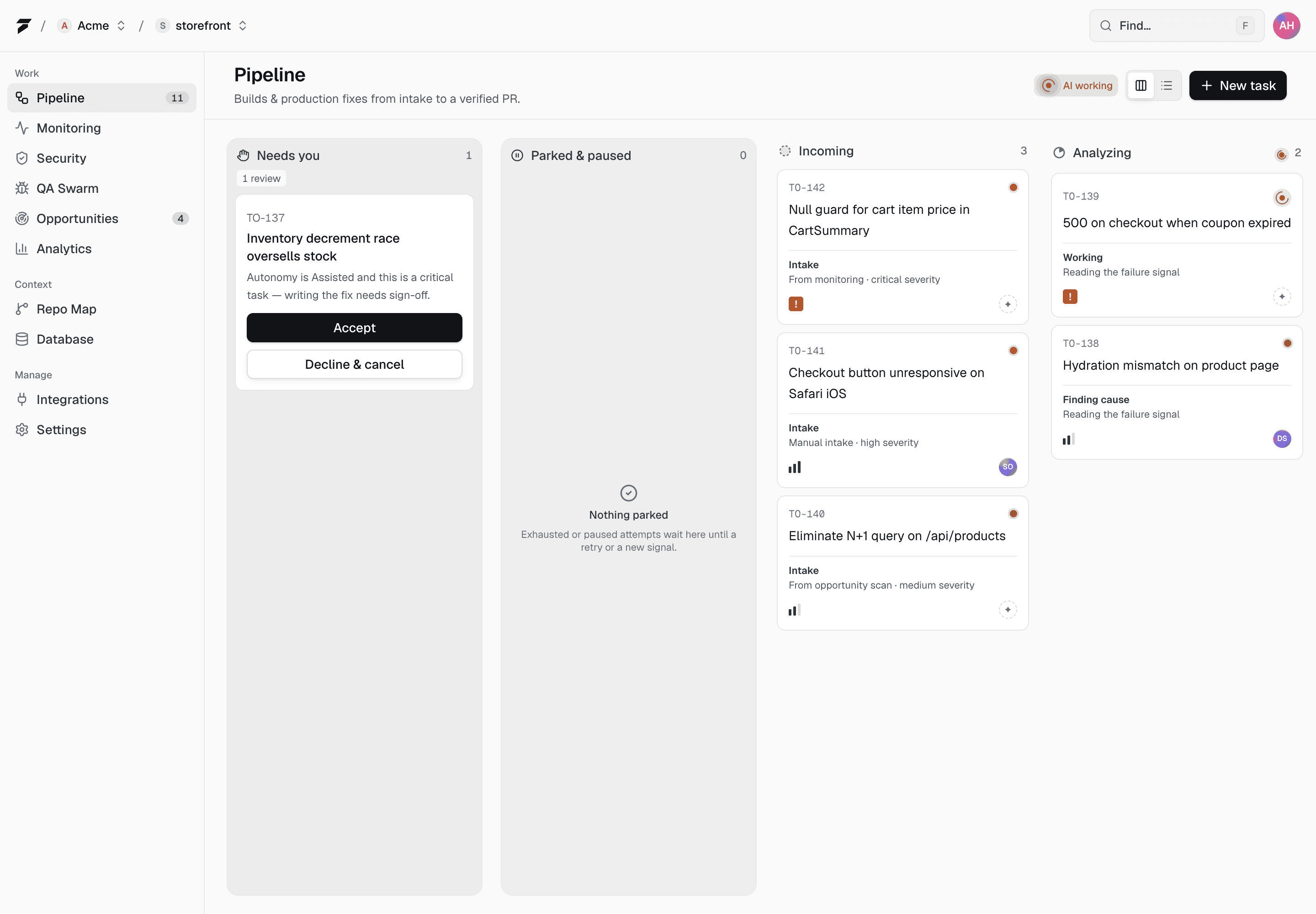
Every fix on one board.
Each error stays linked to triage, branch work, available checks, and the reviewed pull request in one place — nothing hidden.
Built to be trusted
Your autonomous reliability engineer.
Not another dashboard. To200 reads the failure, diagnoses a likely cause, writes a branch-only fix, runs available checks, and opens a pull request within the limits you set.
It shows its reasoning
Every task opens with a written assessment — root cause, the plan, and a confidence score. Read the why before anything ships.
Missing await drops order-confirmation emails
AI assessment
Root cause. Fire-and-forget sendEmail in a serverless handler.
Plan. Await the send; move to a queued job with retry.
It shows the evidence
To200 runs the checks available in the repository and attaches the results, assessment, and confidence to the pull request.
Verification evidence
results attached to the branch-only PR
It ends at a change, not an explanation
An investigation ends when someone can explain the failure. To200 keeps going: a branch-only fix, the checks available in the repository, and a pull request carrying the assessment and verification evidence. What reaches review is a diff you can merge, not a diagnosis you still have to implement.
Await the confirmation send & queue the retry
You set how far it goes
Choose when To200 may triage, write a repair branch, and open a pull request. Human review stays between the PR and main by default; Scale and High volume owners can deliberately enable merge-to-main under repository rules.
Autonomy
Free: Manual + Assisted · Pro: Auto-PR · Scale: Autopilot